
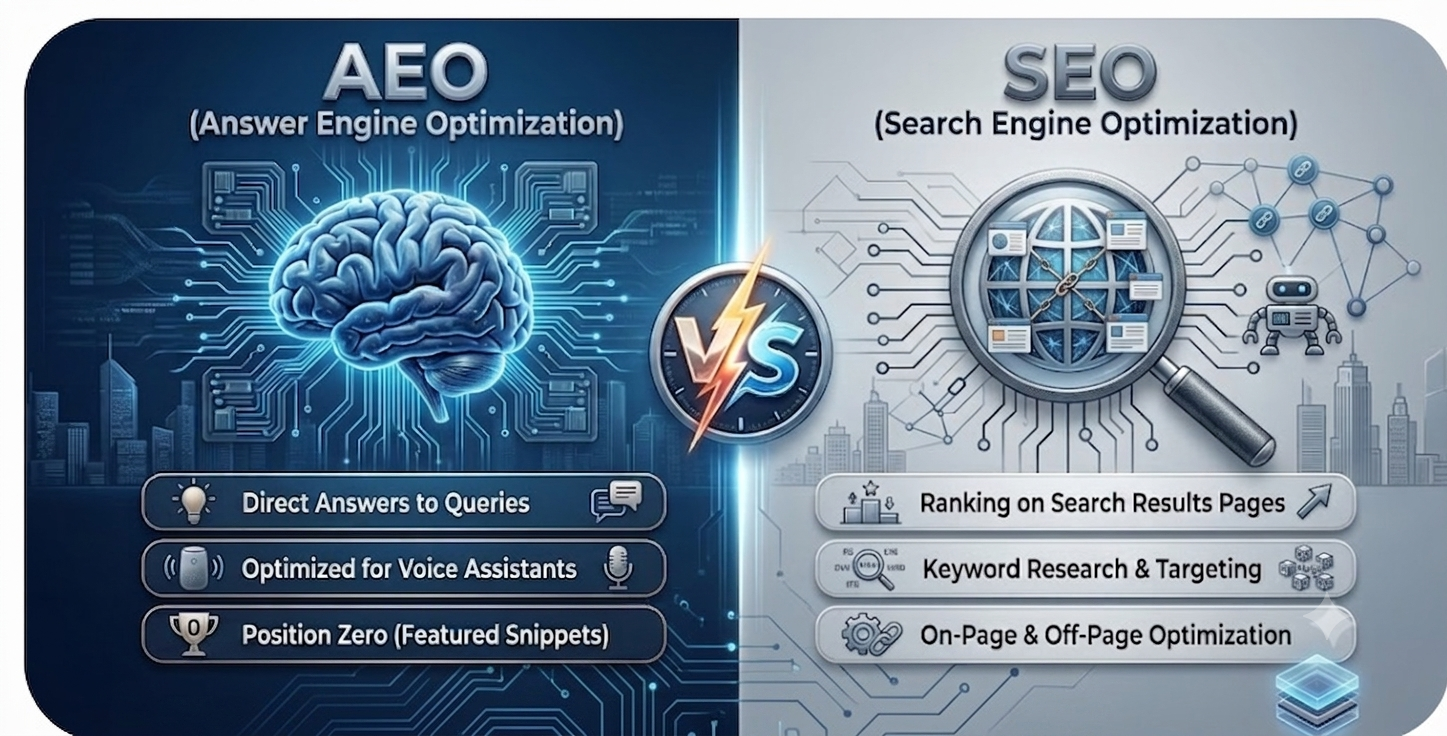
What Is SEO?
Search Engine Optimization is the practice of improving a website so it ranks higher in traditional search engine results — primarily Google. The goal is simple: when someone searches a relevant keyword, your page shows up on page one, they click it, and they land on your site.
SEO relies on:
Keywords — matching the words people actually type into search boxes
Backlinks — other sites linking to yours as a signal of authority
On-page technical health — site speed, mobile-friendliness, structured URLs, meta tags
Content depth — comprehensive pages that satisfy search intent
The end goal of SEO is a click — a visitor landing on your page.
What Is AEO?
Answer Engine Optimization is the practice of structuring your content so AI-driven answer engines — ChatGPT, Perplexity, Google's AI Overviews, Gemini, and voice assistants — can find it, understand it, and use it directly in the answer they give someone.
Instead of trying to win a click, AEO tries to win the citation — being the source an AI model pulls from and, ideally, names or links to when it answers a question.
AEO relies on:
- Direct, extractable answers — a clear, self-contained sentence or paragraph answering a specific question, not buried three paragraphs into a long intro
- Structured data and schema markup — FAQ schema, how-to schema, and organization schema that make your content machine-readable
- Clear entity signals — being unambiguous about who you are, what you do, and what makes you credible (this overlaps with what SEO calls E-E-A-T: Experience, Expertise, Authoritativeness, Trust)
- Conversational phrasing — writing the way people actually ask questions ("how much does X cost in Gurgaon" rather than just "X pricing")
SEO vs AEO: The Core Difference
| Aspect | SEO | AEO |
|---|---|---|
| Goal | Rank high, earn a click | Get cited or quoted directly in an AI answer |
| Primary Surface | Google, Bing search results pages | ChatGPT, Perplexity, AI Overviews, voice assistants |
| Success Metric | Organic traffic, rankings, CTR | Citations, brand mentions in AI answers, share of voice |
| Content Style | Long-form, keyword-optimized pages | Concise, direct-answer blocks within longer pages |
| Technical Layer | Meta tags, backlinks, site speed | Schema markup, structured Q&A, clean semantic HTML |
| User Outcome | Visits your website | May get their answer without visiting your website at all |
The important thing to understand: AEO doesn't replace SEO — it sits on top of it. AI answer engines still rely heavily on traditional search indexes and ranking signals to decide which sources to trust and pull from. A page with poor SEO fundamentals (slow load time, thin content, no authority signals) is far less likely to get cited by an AI model, regardless of how well-structured its FAQ section is.
Where Do You Start With AEO?
You don't need to rebuild your entire content strategy. Start with these, in order:
1. Audit your existing content for "extractable answers"
Go through your top pages and ask: if someone asked an AI model the exact question this page targets, is there one clear sentence or short paragraph the AI could lift as the answer? If your answer is buried in marketing language, rewrite it to lead with the direct answer, then elaborate.
2. Add FAQ sections with structured markup
Every service or product page should have a short FAQ block addressing the 4–6 questions your actual customers ask, marked up with FAQ schema. This is the single highest-leverage AEO change most businesses can make right now.
3. Strengthen entity clarity
Make sure your "About," service pages, and homepage clearly and consistently state who you are, what you do, where you operate, and what credentials or results back that up. AI models weigh consistency and clarity of these signals heavily when deciding whether to trust a source.
4. Keep your technical SEO foundation solid
Fast load times, clean HTML structure, mobile responsiveness, and a logical site architecture aren't just SEO checkboxes — they directly affect whether AI crawlers can access and parse your content at all.
5. Write for how people actually ask questions
Shift some of your content from keyword phrases ("best digital marketing agency Gurgaon") to natural questions ("what's the best digital marketing agency in Gurgaon for a small business?"). This mirrors how people phrase prompts to AI tools.
6. Monitor citations, not just rankings
Start periodically checking whether ChatGPT, Perplexity, or Google's AI Overview mention your brand when you ask questions in your niche. There isn't yet a mature analytics standard for this the way Google Search Console exists for SEO, but manual spot-checks are a reasonable starting point in 2026.
The Bottom Line
SEO and AEO aren't competing strategies — they're the same discipline responding to two different ways people now find information. Businesses that treat AEO as "SEO plus a few FAQ boxes" are underestimating it; businesses that ignore SEO fundamentals while chasing AEO are building on sand. The businesses winning both channels right now are the ones auditing their content for direct-answer clarity while keeping their technical SEO foundation strong.
Not Sure Where Your Site Stands?
Inquisitive Digital runs SEO/AEO/GEO audits that check both sides of this — traditional ranking signals and AI-citation readiness — and hands you a clear roadmap of what to fix first.