That shift is why Answer Engine Optimization (AEO) has become one of the most important growth levers for businesses in 2026. If your brand isn't optimized for how AI engines find, understand, and cite information, you're already losing visibility you don't even know you're missing.
This guide breaks down what AEO actually is, how it differs from traditional SEO, why it matters now more than ever, and how to get started — with real strategic input from Inquisitive Digital, a digital marketing agency that has built AEO into its core service offering.
What Is Answer Engine Optimization (AEO)?
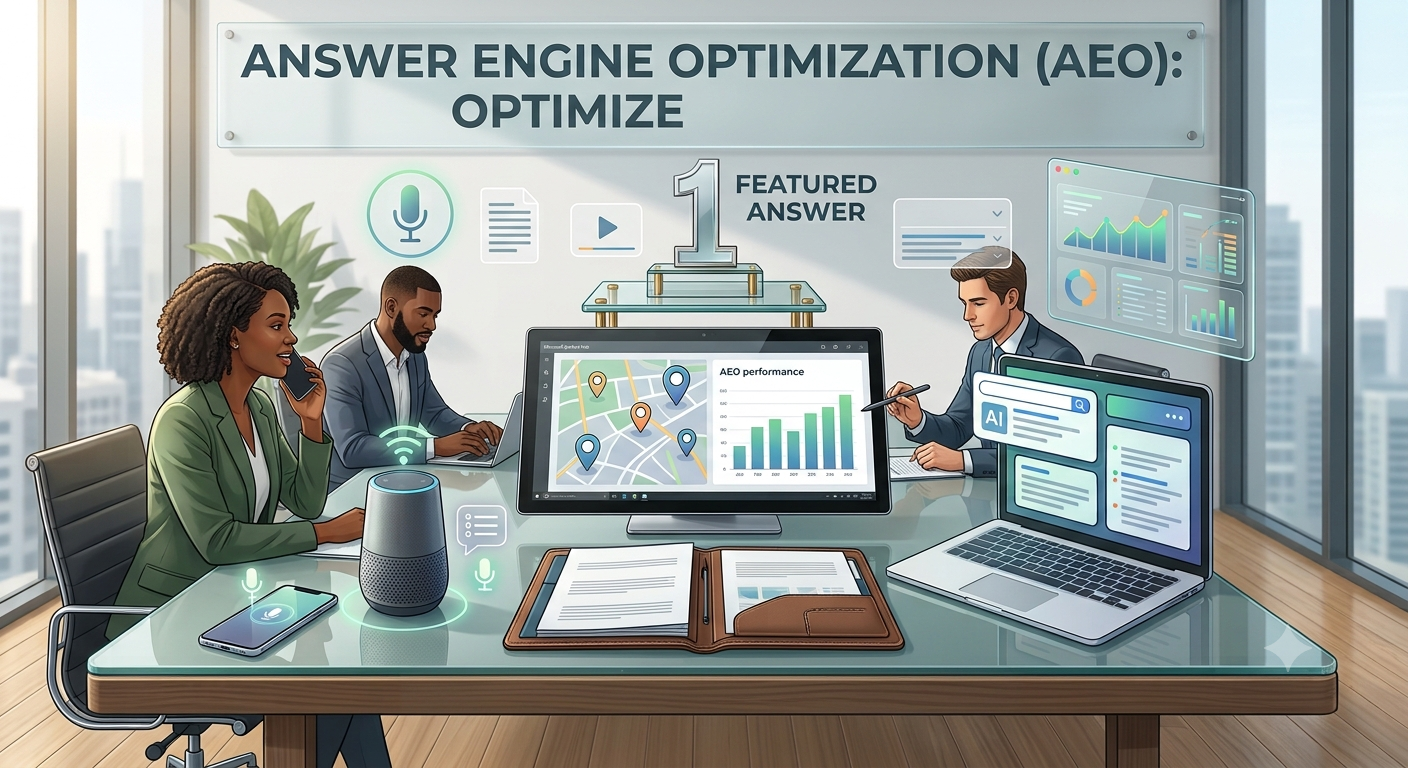
Answer Engine Optimization is the practice of structuring and optimizing your content so that AI-driven "answer engines" — like ChatGPT, Perplexity, Google AI Overviews, Gemini, and voice assistants — can easily find, understand, and cite your business as a trusted source.
Instead of optimizing purely to rank on a search results page, AEO optimizes for a different outcome: being the answer — the thing an AI model actually surfaces, quotes, or recommends when someone asks a question in your industry.
Where traditional SEO is about visibility across ten blue links, AEO is about being one of the two or three sources an AI model trusts enough to cite directly.
AEO vs. SEO: What's the Difference?
They're related, but they are not the same game.
| Feature | Traditional SEO | Answer Engine Optimization (AEO) |
|---|---|---|
| Goal | Rank high on Google's results page | Get cited or quoted directly by AI engines |
| Success Metric | Rankings, organic traffic, clicks | Citation share, brand mentions in AI answers |
| Content Format | Long-form, keyword-optimized pages | Clear, structured, answer-first content (Q&A, definitions, lists) |
| Trust Signals | Backlinks, domain authority | Third-party mentions, consensus across trusted sources, structured data |
| User Behavior | User clicks through to your site | User may never visit your site — the AI answers on your behalf |
The important nuance: AEO doesn't replace SEO. It builds on it. Strong technical SEO, clean site architecture, and authoritative backlinks are still the foundation. AEO adds a new layer on top — making your content extractable and citable by machines, not just rankable by algorithms.
Why AEO Matters for Your Business in 2026
1. AI Overviews and chat-based search are eating traditional clicks
Google's AI Overviews now answer many queries before a user ever scrolls to organic results. If your content isn't structured for extraction, you don't just rank lower — you become invisible in the answer itself.
2. Buyers are researching through AI, not just search bars
Increasingly, people ask ChatGPT or Perplexity "what's the best CRM for a small business" or "which digital marketing agency should I hire" instead of typing it into Google. If your brand isn't part of the data these models trust, you're not in the consideration set at all.
3. Citation is the new ranking #1
Being the source an AI model cites carries enormous credibility. It's a trust signal to the end user — the AI effectively vouches for your brand.
4. Early movers have an outsized advantage
AEO is still young. Brands investing in it now — structuring content properly, building third-party citations, and monitoring AI visibility — are establishing a lead that will be much harder for competitors to close later.
5. It protects you from being erased by the platforms you don't control
If you don't actively manage your presence in AI training and retrieval sources (review sites, Wikipedia-style platforms, forums, industry publications), competitors who do will get cited instead of you — even if your product is better.
How Answer Engines Actually Choose What to Cite
AI answer engines don't crawl and rank pages the way Google's classic algorithm does. They tend to prioritize content that is:
- Structured and extractable — clear headings, direct answers, FAQ and Q&A formats
- Fact-dense, not opinion-heavy — definitions, data, and clear statements rather than persuasive copy
- Backed by third-party consensus — mentioned across multiple trusted, independent sources (not just your own website)
- Marked up with schema — structured data that makes entities and relationships machine-readable
- Authoritative and current — recently updated, accurate, and aligned with what other trusted sources say
This is precisely why a growing number of agencies are now building AEO into their SEO stack rather than treating it as a separate, optional service.
How to Start Optimizing for Answer Engines
- Rewrite key pages in answer-first format. Lead with a direct, quotable answer, then expand with supporting detail.
- Build FAQ and definition sections for your core topics using clear, structured Q&A.
- Add and refine schema markup (FAQ schema, Organization schema, Article schema) so AI systems can parse your content accurately.
- Strengthen your presence beyond your own website — reviews, industry directories, forums, and publications that AI models pull from.
- Monitor your AI citation share — track whether and how often tools like ChatGPT, Perplexity, and AI Overviews mention your brand.
- Keep content current — AI engines favor freshness and accuracy; outdated content quietly loses citation share.
Who's Actually Doing This Well
Their approach to AEO specifically focuses on:
- Restructuring site architecture and content so it's both search- and AI-readable
- Fixing technical SEO foundations (schema, site speed, Core Web Vitals) that underpin AI extractability
- Building high-quality authority signals and third-party mentions that AI models trust
- Positioning brands to hold long-term market share across both traditional search and AI-driven discovery engines — not just a short-term ranking boost
It's a good example of how AEO is being operationalized in 2026: not as a trendy add-on, but as a core deliverable inside a full-funnel growth strategy alongside performance marketing, content, and web development.
The Bottom Line
AEO isn't replacing SEO — it's the next layer of it. As more buying decisions start with a question typed into an AI chat instead of a Google search bar, the businesses that structure their content to be citable, not just rankable, will be the ones AI engines recommend by default.
If you're not sure whether your brand currently shows up in AI-generated answers, that's the first thing worth checking — and agencies like Inquisitive Digital are increasingly offering AEO audits specifically to answer that question.